


Fifteen trades will move through your home. Every one of them has a system. This is yours.
Right now you have a number you're hoping holds, a list of rooms, and a decision you haven't been able to settle: live in or move out, builder or run it yourself, everything at once or one stage at a time. What you don't have is a way to know whether the quotes are comparable, whether the trades are in the right order, or whether the variation you're asked to approve mid-build is real. The 12 Phase System closes that gap at whole-home scale, from strategy and budget to the day you hold every certificate and the last defect is fixed.
What is the Full Home Renovation Blueprint?
It's the complete planning system for a whole-home renovation in Australia: 12 phases, 168 decision points, every cost and the exact questions to ask, from first strategy session to final handover. It coordinates the fifteen trades that pass through a full renovation in their correct 21-step sequence, so decisions in one room never blindside the next. Four interactive modules plus a Renovation Cost Calculator, included free, working together as your whole-home renovation planner. Yours permanently, whether you manage the build yourself or run a builder with confidence.

Why do most whole-home renovations cost more than the quote?
Because the most expensive decisions are made before a single trade picks up a tool, and at whole-home scale, every one of them is multiplied across rooms. The builder has a sequence. Each trade has a process. You have a mood board, a spreadsheet, and a number you're hoping holds. It rarely does: nearly 2 in 5 renovations run over budget, and rarely because of one big surprise. The blow-outs trace back to decisions made after work started: materials upgraded on the fly, scope that quietly grew. On a single room that's painful. Across a whole home (fifteen trades, twenty-one steps, months on site) it's the difference between finishing the project and pausing it half-done.
A tiler booked before the waterproofer has finished. A variation approved in a hallway conversation that lands as a five-figure invoice. A progress payment released the day before an inspection would have failed. None of these are bad luck. They're what happens when the only person watching the whole home doesn't have a system for it.
What does it cost to walk into a whole-home renovation unprepared?
On an Australian whole-home renovation (typically $150,000 to $280,000 for a standard scope, and well past $480,000 for larger structural projects), arriving unprepared doesn't cost hundreds. Each of these is a single documented line item from the Protection Guide's forty:
$497 is less than half of one per cent of a typical whole-home budget. Stop one line on this list, once, and the Blueprint has paid for itself many times over. It protects most when you have it before you sign anything.
Homeowners who ran their renovation on the Blueprint system
Verified reviews from Property Blueprint Co.'s room Blueprints. The Full Home edition is the same system, scaled to the whole house.
What's inside the Full Home Blueprint?
One system, four modules, plus the Renovation Cost Calculator, included free. The Blueprint teaches you the 12 phases; the other three hand you the tools to run them. The same architecture as our Kitchen and Bathroom Blueprints, scaled to the whole home.
Built from years of hands-on renovation experience. Every phase tested on real Australian projects, not theory.
The Renovation Blueprint
The 12 Phase System at whole-home scale: what happens in every room, when, and what to ask. 168 decision points from strategy to handover, plus a worked example of a real whole-home renovation and a plain-English glossary.
The Protection Guide
40 costly mistakes, 24 trade red flags and 19 blind-spot scenarios, each with a documented dollar range and the exact way to avoid it.
The Planning Toolkit
12 interactive tools that keep your budget, variations, payments and certificates under control, saving automatically and working offline.
The On-Site Handbook
6 reference sheets (every room's measurements, the 21-step build sequence, daily checks, payments, contacts) on your phone, with or without signal.
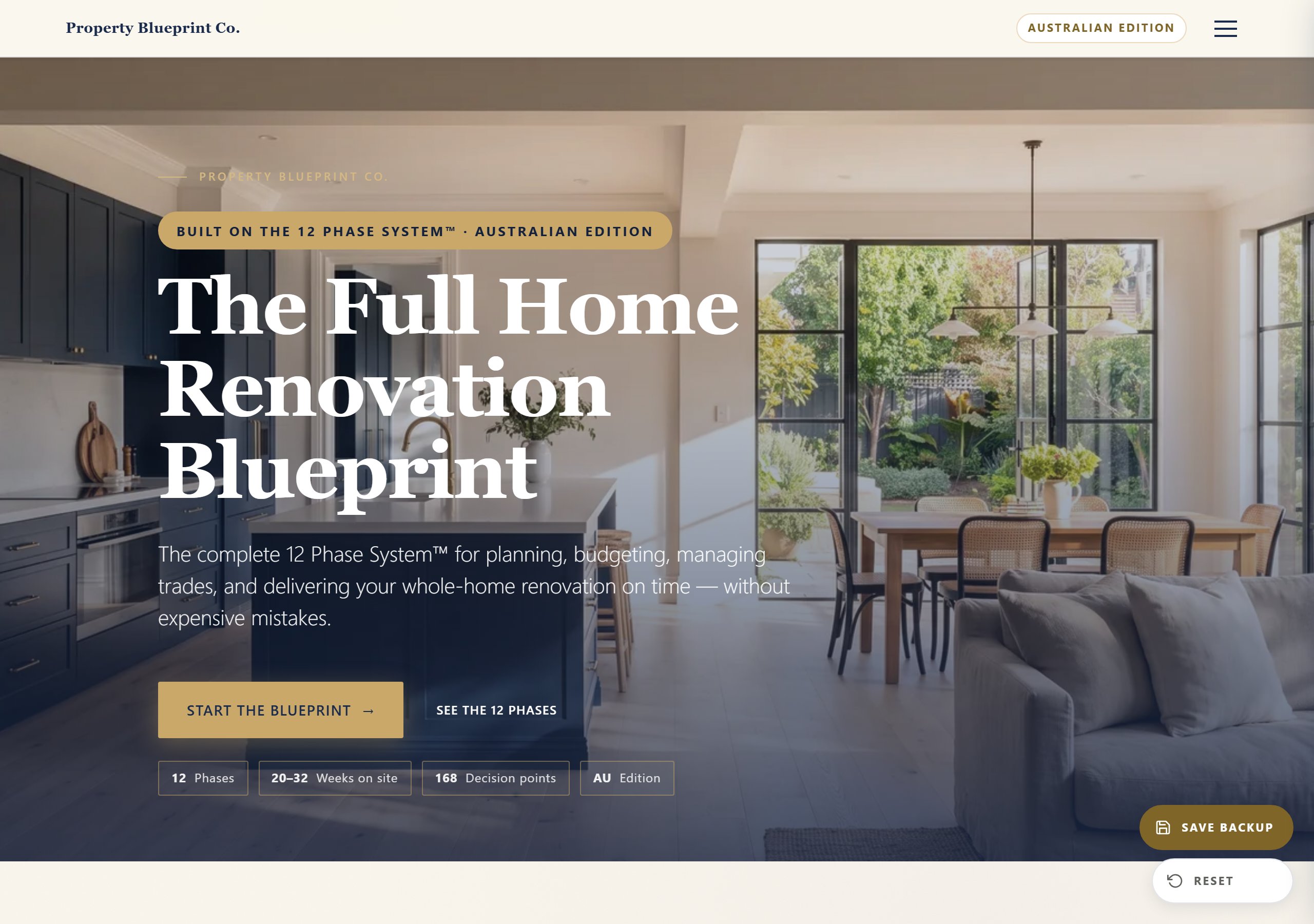
You walk into every site meeting knowing exactly what should be happening in every room, and exactly what to say when it isn't.
On a whole-home project, control slips away one room at a time. The Blueprint hands it back as one system: twelve chronological phases covering the entire build, with every decision (live in or move out, staged or simultaneous, which trades, what order, what to hold back until inspection) captured at a GO / NO-GO checkpoint before money moves. 168 decision points, tracked as you go.
Releasing a progress payment on a home where the rough-ins haven't passed inspection. You know what “done” looks like in every room before a cent leaves your account.
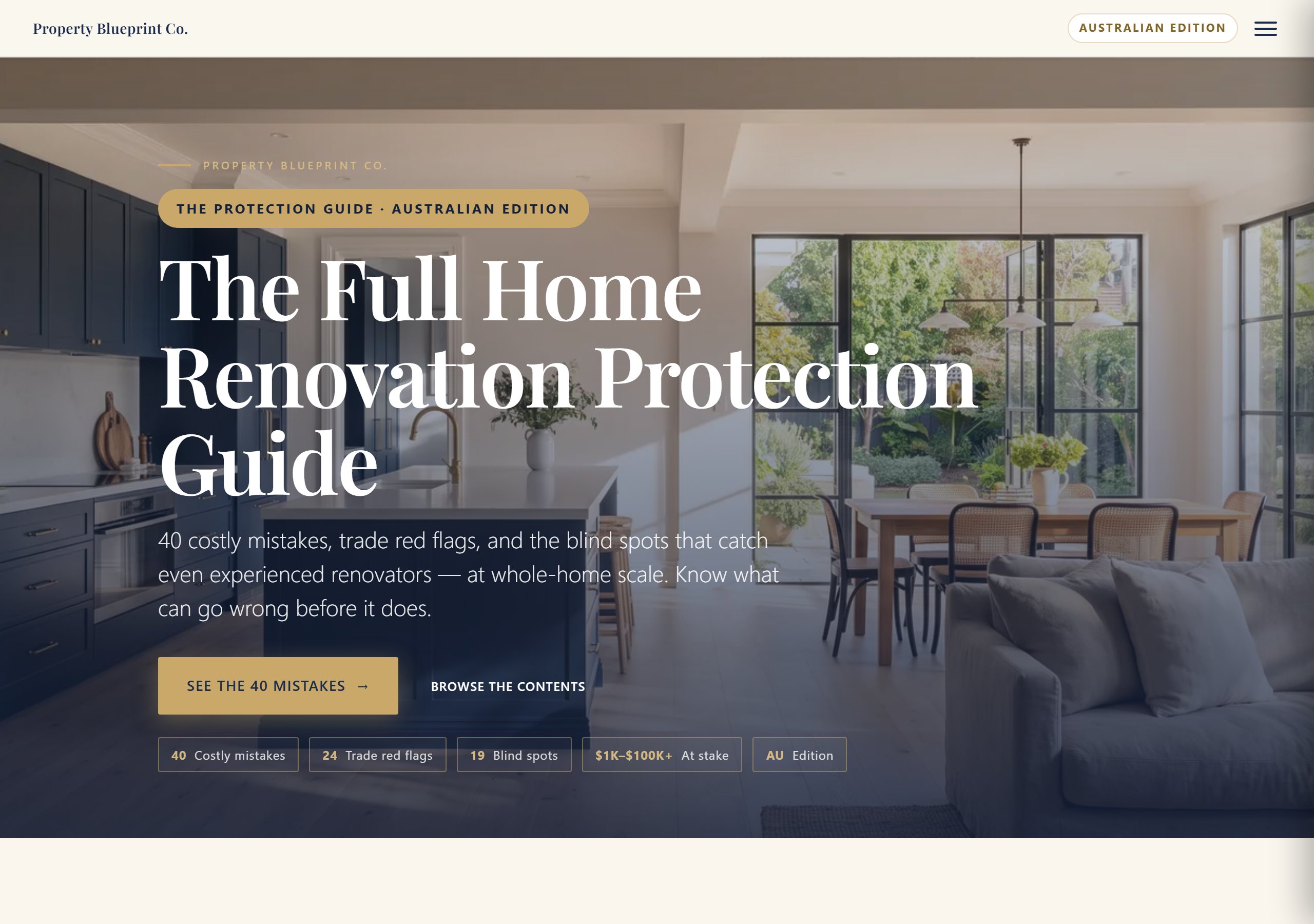
You walk in already knowing what goes wrong at whole-home scale, before it has the chance to go wrong on yours.
Not theory. The specific failures of whole-home projects, each with a documented cost range from $1,000 to $100,000-plus and the exact way to avoid it: demolition started before selections are locked, the deposit structure that hands a trade your leverage, the scope gap between two trades that each assumed the other had it. The 24 red flags are sorted by where they surface (quoting, contracts, on site, on invoices), so you catch the wrong trade before any money changes hands.
Signing with the wrong trade, on a project where fifteen of them will quote you. You learn to read the warning signs while it still costs nothing to walk away.
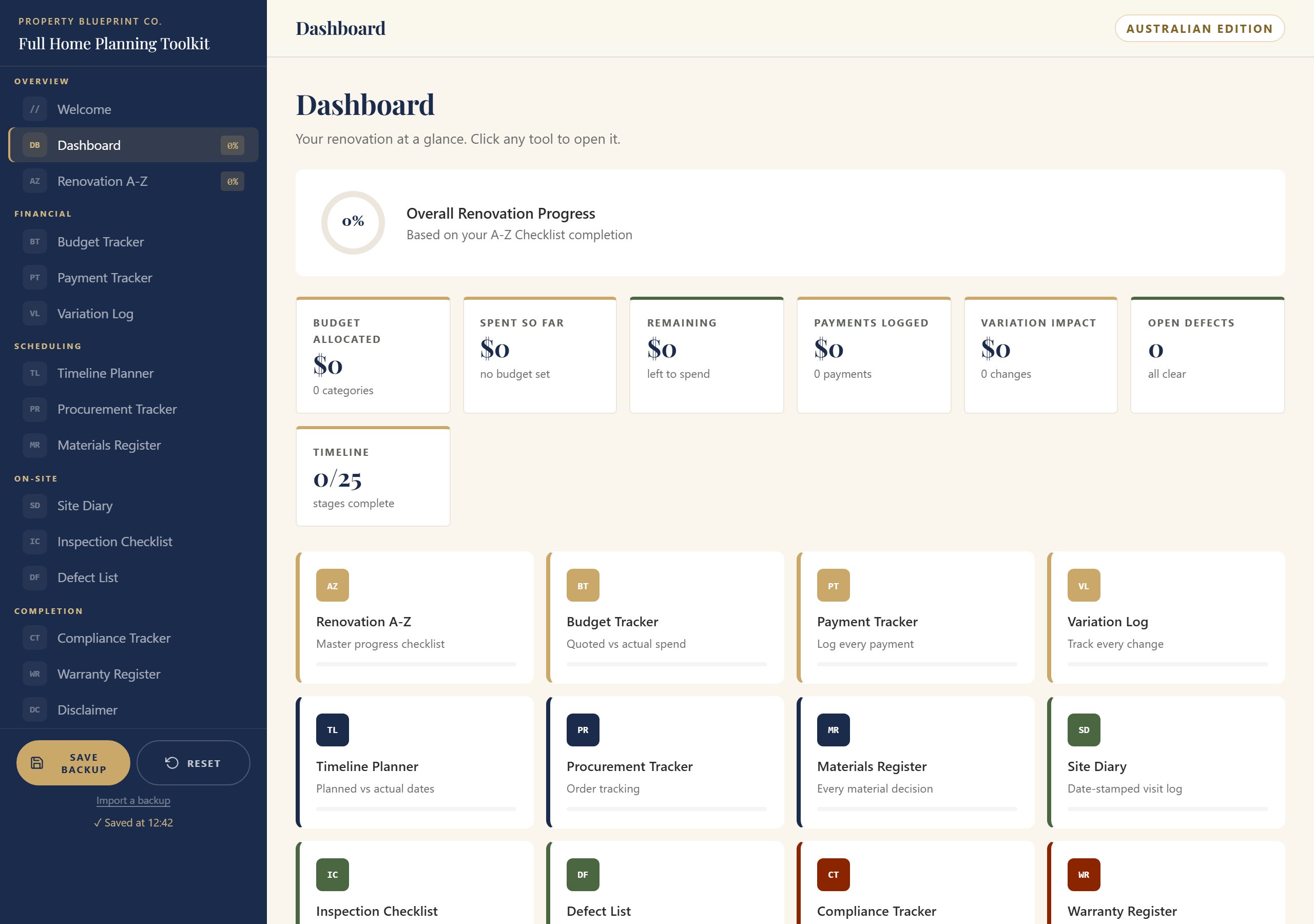
Every number, every change and every payment across the whole home in one place, so nothing slips past you and no one can rewrite the story later.
When a trade says “that was always extra,” the homeowner who can't point to the record is the one who pays. This is where you keep the record for the entire project: your budget against every quote, every variation in writing, every payment milestone, every certificate, saved automatically on your device and working offline on a noisy site. Twelve tools on one dashboard, anchored by a 77-item Renovation A–Z that tracks the whole build.
Stay on budget
- Budget Tracker
- Payment Tracker
- Variation Log
Stay on schedule
- Timeline Planner
- Procurement Tracker
- Materials Register
In control on site
- Site Diary
- Inspection Checklist
- Defect List
Finish protected
- Compliance Tracker
- Warranty Register
- Renovation A–Z Checklist
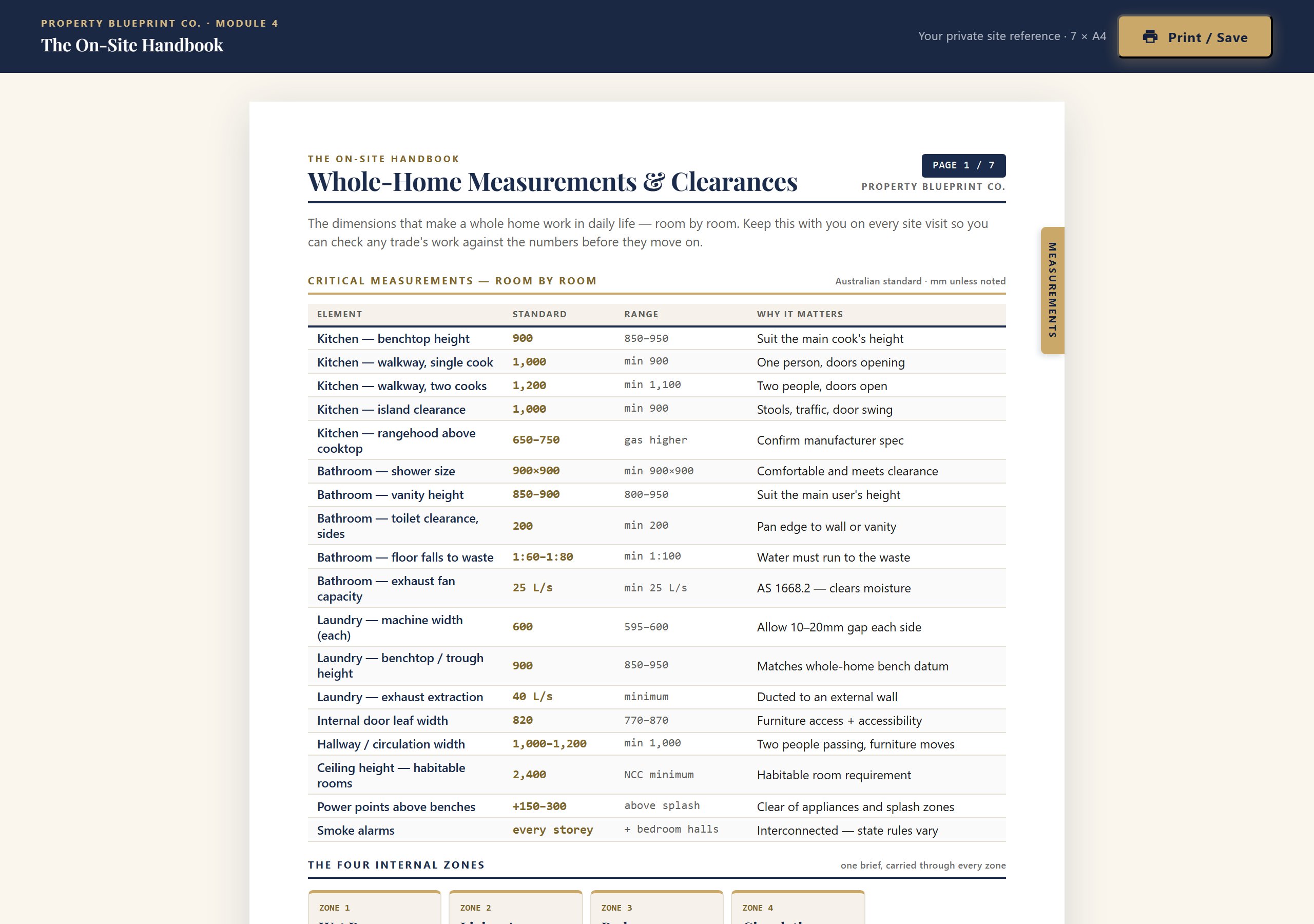
The right numbers and the right questions in your pocket, so you can check any trade's work, in any room, before they move on.
A whole-home site is loud, fast, and no place to read a manual. The Handbook strips everything down to 6 reference sheets built for your phone. When the tiler asks about falls, the carpenter about door clearances or the electrician about power point heights, you answer with the number, not a shrug.
Your renovation is decided before the first trade arrives.
Built for how Australia actually renovates, state by state.
Every permit threshold, licensing rule, owner-builder requirement and dollar figure is the Australian one, tuned to your state.
Every state & territory covered
Approval pathways, owner-builder thresholds, licensing bodies and consumer rules, for NSW, VIC, QLD, WA, SA, TAS, ACT and the NT.
Australian building rules, in plain English
Mapped to the National Construction Code and your state's building authority, translated into what to check at rough-in and handover.
Aussie trades & real AUD pricing
Built around state-based licensing and Australian Standards, with current Australian-dollar costs for the whole build.
The details an Australian certifier checks
Waterproofing checks before a single tile, rough-in inspections before the walls close, smoke alarms and pre-demolition asbestos testing, flagged before your trades start.
This Blueprint wasn't written from a textbook. Every phase, checklist and red flag came out of managing real renovations end to end, and it's written down so you can run yours the same way.
“After managing my own renovations end to end, the pattern was obvious: the difference between the build that runs to plan and the one that runs away is never luck. It's whether the owner knows what should happen next. That's the whole job of the Blueprint.”
Is the Full Home Blueprint right for you?
Built for you if…
- You're renovating most or all of your home as one project (kitchen, bathrooms, living areas and more), managing it yourself, or running a builder and wanting to stay in control
- You have quotes back and no reliable way to tell if they're accurate, comparable or fair
- You're about to sign a building contract and want to know exactly what to check first
- You're weighing the big calls right now: live in or move out, staged or all at once, builder or owner-managed
- You've had a renovation go sideways before and are determined not to repeat it at whole-home scale
- You're an investor repositioning a property anywhere in Australia
This is not a DIY construction guide
- You'll still hire licensed builders and registered electrical, plumbing & gas trades; the system assumes you will
- What it teaches is everything around the trades: how to brief, compare, contract, sequence and manage them, and handle variations
- Renovating one room at a time instead? The room Blueprints are built for exactly that; this one is for the whole home run as one build
- No prior renovation experience required
- Built for first-timers, and for people who learned the hard way last time
Instant. Permanent. Works anywhere.
30-day money-back guarantee · one email, full refund · no conditions, no forms, no questions